

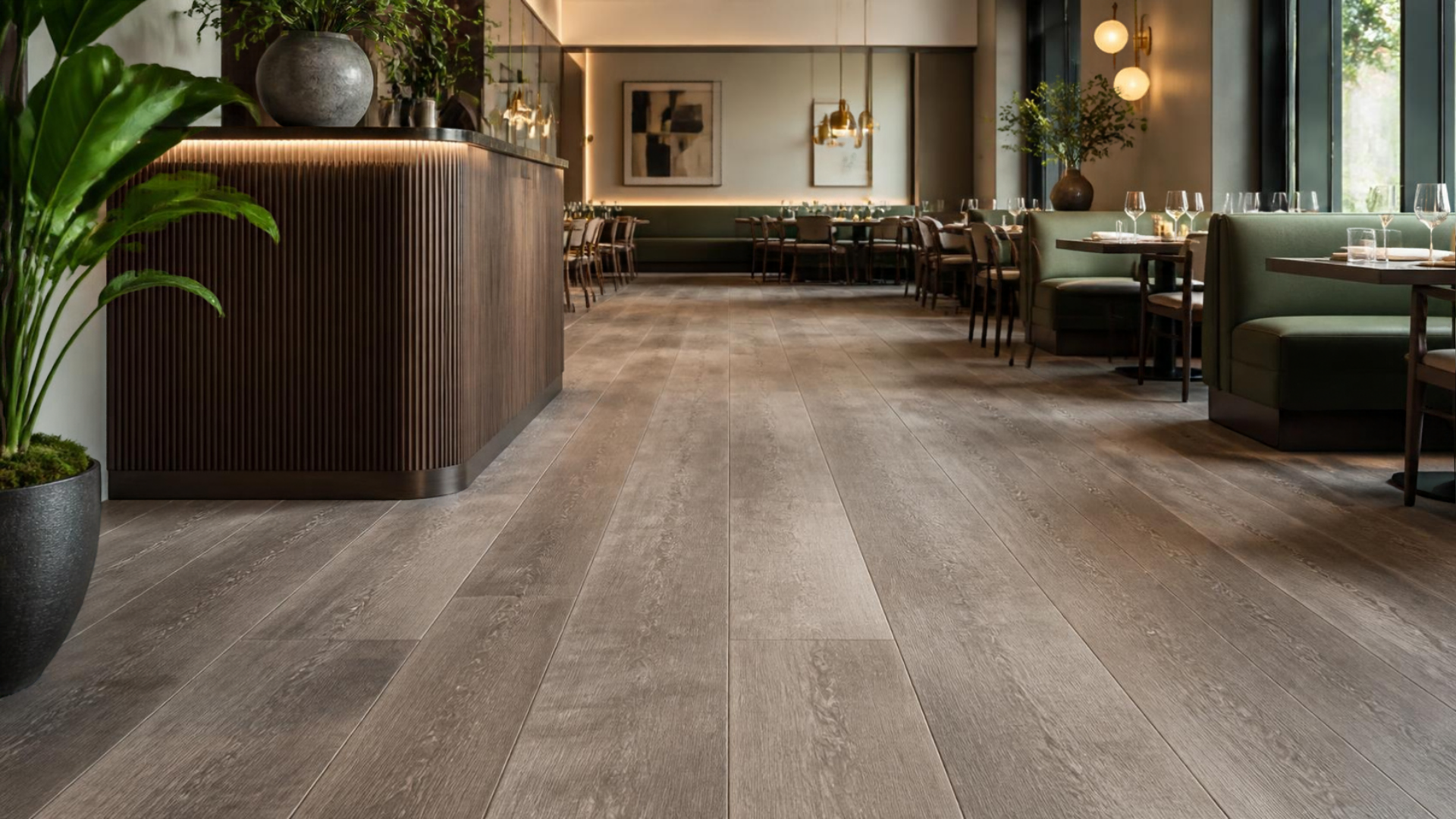
Over ten years, keeping a commercial floor clean and presentable usually costs a business more than buying and installing it did. The sticker price is the part everyone compares, and it is the part that matters least by the end. What runs up the real bill is labor: the stripping, waxing, buffing, patching, and eventually replacing that a floor demands long after the crew drives away. Pick the floor that's cheapest to buy and you can easily sign up for the one that's most expensive to own. The floors worth weighing here are the four a Big Island business actually chooses among: vinyl composition tile, luxury vinyl, sheet vinyl, and carpet tile.
The Purchase Price Is Only the Down Payment
The price of a commercial floor is only the down payment, and the maintenance is the mortgage. That gap has a name in building economics: life-cycle cost. ASTM International (the standards body behind the test methods most of the trades run on) defines life cycle cost in its E917 practice as the way to judge whether a higher upfront cost is justified by: lower future operating; maintenance; repair, or replacement costs. Read that the way a facility manager does and it stops being abstract. A floor that costs more to install but almost nothing to keep can turn into the cheaper floor by year three, and the only way to see that is to add up the whole decade instead of the invoice. Cheap upfront is a real number. It's just not the number that decides this.
The VCT Trap: Cheap to Buy, Expensive to Keep
Vinyl composition tile, or VCT, is the cheapest hard commercial floor to buy and the most demanding to keep, which is the trap. Keeping VCT looking right means a floor finish, the wax layer, that wears off under traffic and has to be stripped and reapplied on a schedule. Commercial floor-care guidance from janitorial suppliers puts that strip-and-wax cycle at every 6 to 12 months in an ordinary space, and every 3 to 6 months in hallways, lobbies, and retail aisles, on top of daily dust-mopping and monthly buffing. Each of those passes is labor, chemicals, equipment, and a room closed off while the floor dries. Over a decade that recurring bill dwarfs the low price on the tile, and it is the reason a floor that looked like a bargain on the quote becomes the most expensive one in the building.
Why LVT and Carpet Tile Cost Less to Own
Luxury vinyl and carpet tile cost more to buy than VCT and far less to keep, for two different reasons. Luxury vinyl carries its protection built in. Commercial vinyl is graded by its wear layer in mils, and a business floor wants 20 mils or more, up to 28 to 40 mils for the hardest use, which is the armor that lets the commercial LVT we carry skip the wax VCT lives on. A damp mop and a neutral cleaner is most of the program. Carpet tile saves money a second way, through how it gets repaired. A stained or burned tile is pulled and swapped for a spare, so the fix is one square instead of a whole room, and the standard advice is to keep 5 to 10 percent of the order as attic stock for exactly that. Broadloom can't do this, since a damaged patch there means a visible repair or a new roll.
How Long Each Commercial Floor Actually Lasts
Service life is the other half of ownership cost, because a floor that has to be torn out and redone at year eight is carrying a hidden replacement bill. Continental Flooring, a contractor that floors government and institutional buildings, puts vinyl of every kind, VCT, sheet, and LVT, at 10 to 20 years of service, and carpet tile and broadloom at 5 to 15 years, with most government facilities averaging 8 to 10 years on carpet. Construction is what moves a floor inside that range. A thin builder-grade square wears out fast, while a commercial-grade nylon carpet tile is quoted at 15 to 20 years. The lesson for a buyer is to read the spec, because two products sold under the same category name can have very different lifespans and very different ten-year costs.
Ten-Year Ownership, Floor by Floor
| Floor | Upfront cost | Maintenance burden | Repair method | Typical service life |
|---|---|---|---|---|
| VCT | Lowest | High: strip and wax every 6 to 12 months, buffing between | Reset loose tiles; refinish the field | 10 to 20 years |
| Luxury vinyl (LVT) | Higher | Low: damp mop, no wax with a 20-mil-plus wear layer | Swap a plank or tile | 10 to 20 years |
| Sheet vinyl | Moderate | Low: damp mop; welded seams keep water out | Patch or re-weld a seam | 10 to 20 years |
| Carpet tile | Moderate | Moderate: vacuum and periodic extraction | Swap one tile from attic stock | 5 to 20 years by grade |
The Moisture Failure That Resets the Clock in Kona
The biggest hidden cost in any of these floors is a moisture failure, and it's the one problem you can't patch your way out of. On the Big Island most commercial buildings sit on a concrete slab poured on grade, with no basement and nothing between the floor and the ground but the slab itself, so water moves up through it. Independent Floor Testing and Inspection, a firm that makes its living diagnosing floors that failed, warns that excessive slab moisture drives resilient floors to fail through adhesive re-emulsification, bond failure, bubbling, and delamination, and it reports that carpet over a damp slab grows odors and mold. Most makers cap the acceptable in-slab humidity at 75 to 80 percent, read by the ASTM F2170 probe test at 40 percent of the slab's depth. A floor laid over an untested slab can look perfect for a year and then let go all at once, and on an island where every replacement floor arrives by barge, that reset is the most expensive line in the whole comparison. Testing the slab first is cheap, and understanding how the subfloor decides a commercial floor's fate is cheaper still.
Questions Kona Businesses Ask About Commercial Floor Costs
Is vinyl flooring or carpet tile easier to maintain in a commercial space?
Luxury vinyl is the easier of the two to maintain day to day, because a damp mop handles it and there is no wax to strip. Carpet tile is close behind and wins on repair, since a damaged square swaps out in minutes without touching the rest of the floor. Both beat VCT, which needs the recurring strip-and-wax cycle. The right pick still depends on the room, because carpet tile also softens sound and warms a space in ways vinyl doesn't.
Is cheaper VCT a false economy?
Cheaper VCT is often a false economy in a busy commercial space, because its low tile price comes with a permanent maintenance habit. Stripping and waxing every 6 to 12 months, and more often in high traffic, is labor and downtime that repeats for the life of the floor. VCT still earns its place where a floor gets refinished on a set janitorial program anyway, or where the upfront budget simply won't stretch. Outside those cases, a no-wax floor usually costs less by the end of the decade.
How long should a commercial floor last on the Big Island?
A commercial floor on the Big Island should last 10 to 20 years for vinyl and 5 to 20 years for carpet tile by grade, provided the slab was tested and the floor was matched to the traffic it gets. Island conditions push on both ends: salt and grit at the entry wear a floor faster, and a moisture failure from an untested slab can cut the life to a couple of years. The spec and the slab test matter more here than the brand name on the box.
Pricing a Floor by the Decade, Not the Invoice
The cheapest commercial floor to own is the one whose ten-year total, buying it plus keeping it plus the odds of replacing it, comes out lowest, and that is rarely the floor with the lowest price on the quote. For a lot of Big Island businesses that points to a no-wax luxury vinyl or a modular carpet tile over VCT, though the honest answer turns on the room, the traffic, and what the slab tests at. The commercial floors we install come with that math done out loud, and financing is there when the better-owning floor costs more to buy. When you want the real ten-year number for your space, request a free estimate and we will test the slab, price the options, and show you what each one costs to keep over the years, alongside the price to lay it down.


