

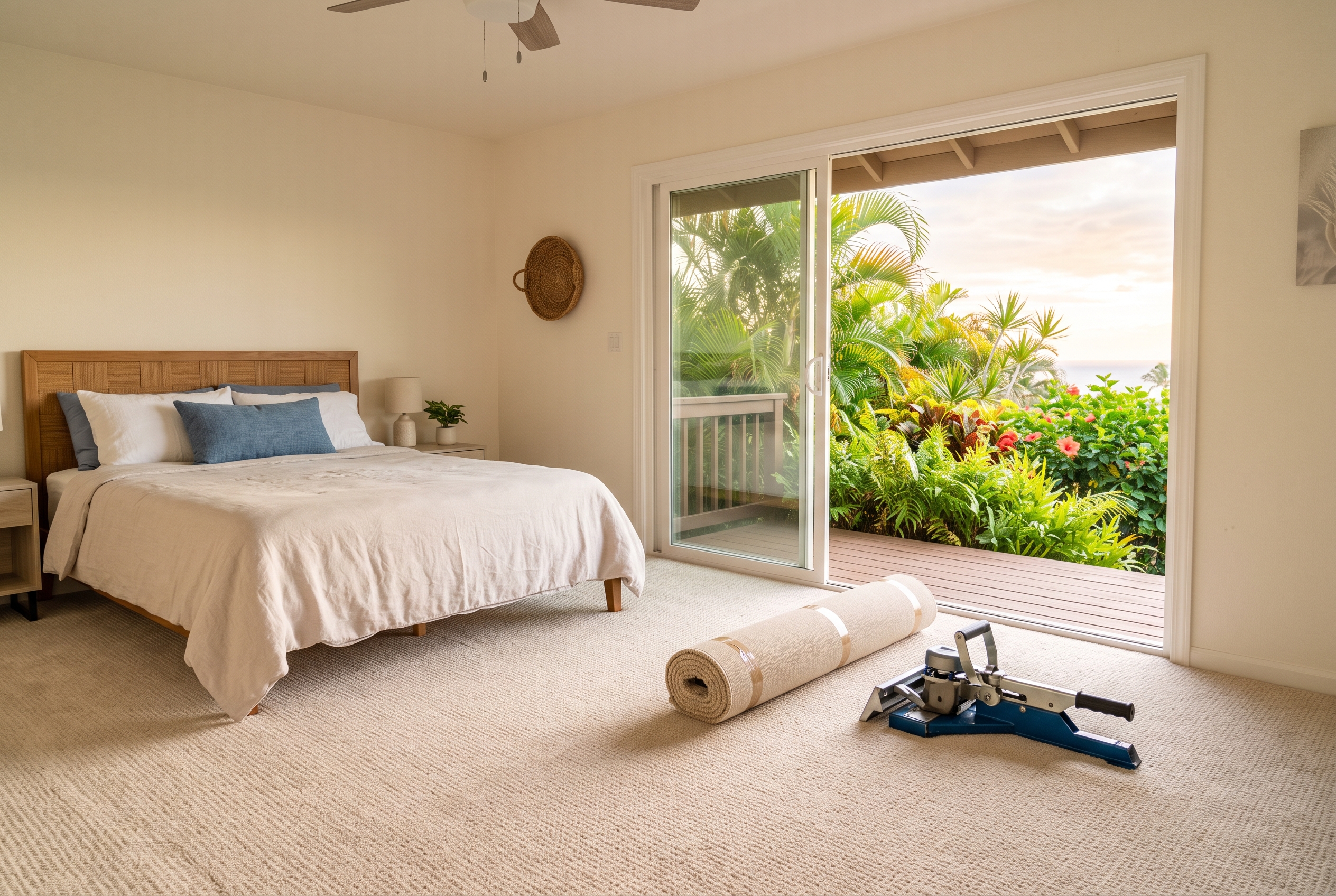
Carpet installation in most homes takes a single day once the rooms are empty. The old carpet and pad come up, tack strip goes around the walls, new pad goes down, and the carpet is cut, seamed and power-stretched into place. Three things decide how your day goes: how much has to come out first, how many rooms and stairs are going in, and whether the floor underneath needs repairs.
A few bedrooms and a hall are usually done in a day, often by mid-afternoon. Your part is emptying the rooms, settling the pets, and being there at the start and the end.
A whole floor with stairs takes a full day and sometimes part of a second. Stairs take the longest for their size, because each step is cut and fastened by hand.
A concrete slab or a ground-floor condo takes carpet well if the slab stays dry. The things to get right are a pad with a moisture barrier and a slab with no history of water.
Carpet that already ripples or has a loose seam rarely needs replacing. A re-stretch with a power stretcher, or a seam repair, usually fixes it in an hour or two a room.
| Stage | What happens | Your part |
|---|---|---|
| Estimate | Rooms measured, seams planned, carpet and pad chosen | Decide the rooms, feel the samples |
| The week before | Carpet ordered and delivered | Finish painting, plan the furniture |
| Morning | Old carpet and pad removed, floor checked | Confirm rooms, settle the pets |
| Midday | Tack strip, pad, carpet cut and seamed | Stay out of the work rooms |
| Afternoon | Power-stretched, trimmed, vents cut | Walk the job with the crew |
| First three days | Smell fades, some fibers shed | Keep fresh air moving, vacuum |
How Long Carpet Installation Takes
Fitting carpet into a typical bedroom takes an hour or two, and a whole floor of a house usually takes a day. The fitting is the quick part. What stretches the day is everything around it: pulling up old carpet and pad, moving furniture, fixing a squeaky subfloor, working around closets and stairs, and lining up a pattern across a seam.
| Job | Typical time | What adds time |
|---|---|---|
| One bedroom with closet | 1 to 3 hours | Old carpet removal, furniture |
| Three bedrooms and a hall | Most of a day | Seams, doorways, closets |
| Living room with a seam | Half a day | Pattern matching, big furniture |
| A staircase | 2 to 4 hours | Wrapped style, landings, turns |
| Whole house with stairs | 1 to 2 days | Subfloor repairs, many rooms |
A few things make the day shorter. Rooms that are already empty, a clear path from the street and a flat place to unroll the carpet each save real time. Damage found under the old pad does the opposite. A soft spot in the subfloor or a stain from an old leak has to be dealt with before new pad goes over it, and that can add an hour or two.
When a job runs to a second day, the rooms finished on the first day can be used that night. Bedrooms are often done first for that reason, so everyone has a bed to sleep in while the living areas and stairs are finished.
The wait before installation day is a separate clock. Carpet is ordered once the rooms are measured and the carpet and pad are chosen, and some styles ship from the mainland. Ask at the estimate when your carpet can be here, then plan the painting and the furniture around that date.
How to Prepare Your Home for Carpet Installation
Preparing for carpet installation mostly means clearing the rooms, finishing other work, and planning the path in from the street. A crew that walks into empty rooms spends its day on your carpet instead of on logistics. Work through this list in the week before:
- Decide who is moving which furniture, and empty the dressers, bookshelves and closet floors in every room getting carpet.
- Finish painting, wallpaper and any other work in those rooms.
- Take down anything breakable near the floor, and unplug and bundle the cords from TVs, computers and chargers.
- Vacuum the old carpet the day before. It cuts the dust when it comes up.
- Clear a parking spot near the door and a path wide enough for a 12-foot roll. A garage, carport or lanai makes a good flat spot for unrolling and cutting.
- Decide where the pets and small children will spend the day.
- If the house runs humid, plan to run the air conditioning or a dehumidifier during installation week.
- Look over the new carpet when it arrives. A visible flaw in color or texture should stop the installation before it starts, while the carpet can still be exchanged.
Who Moves the Furniture
Furniture removal is one of the services we offer, so the heavy pieces do not have to be your weekend project; ask about it at the estimate. Some things stay with you whatever the arrangement: the contents of dressers and closets, anything fragile or valuable, family papers and photos, electronics and their cables, and the bedding.
Closets need their floors cleared completely, but clothes on the rod can usually stay if they hang well clear of the floor. Strip the beds so the frames can be moved easily. Pianos, safes, aquariums and anything that has to be drained or taken apart need a plan agreed before the day. Those are the pieces that turn a one-day job into two.
Painting, Doors and Other Work to Finish First
Paint before new carpet goes in, never after. Drips, rollers and ladder feet are hard on new carpet, and a painter can work faster over the old floor. Plan on a small touch-up along the baseboards afterward, since the carpet edge is pressed right against them.
New carpet on a new pad can sit higher than the flattened carpet it replaces, so check the doors as well. A bedroom door that barely cleared the old carpet may drag on the new one. If new baseboards are part of the plan, have them installed before the carpet. We install baseboards and quarter round as part of our flooring work.
Kids, Pets and Being Home on Installation Day
Yes, be home at the start and at the end of carpet installation. In the morning you confirm which carpet goes in which room and answer questions about closets and doorways. At the end you walk the finished rooms before the crew leaves. In between, you can stay in the house in the rooms that are not being worked on.
Keep children and pets out of the work rooms until the carpet is down. Tack strip is a wooden strip lined with sharp pins, and for a few hours it runs uncovered around every wall. Cats and dogs do best shut in a room that is not being carpeted, or away for the day. The noise of the stretcher and the doors propped open for the roll make escapes easy.
What Happens on Installation Day, Step by Step
Carpet installation follows the same order in almost every home, from the first walk-through to the last vent. Knowing the order lets you see where your job is and what is left.
- The walk-through. The crew confirms each room, the carpet for it and where the seams will fall.
- Old carpet and pad come up. The old carpet is cut into strips, rolled and carried out, and the pad and its staples are pulled. We offer carpet disposal, so the old material does not have to sit in your carport.
- The floor is checked. Staples and debris are cleared and the floor is vacuumed. On a wood subfloor, squeaks get screwed down now, because nobody can reach them once the carpet is on. Soft spots and damaged boards are repaired, and subfloor repair is one of our services.
- Tack strip goes around the walls. The strip is fastened with its pins angled toward the wall. It sits a little less than a carpet's thickness from the wall, so the edge can be tucked into the gap, and it never runs across a doorway. Sound old strip is sometimes kept. On concrete, the strip is fastened with concrete nails or adhesive.
- New pad is laid. The pad is trimmed to the inside edge of the strip, taped at its seams and stapled or glued down. Its seams are kept away from where the carpet seams will fall.
- The carpet is rolled out and cut. Each piece is cut to the seam plan with a few inches to spare at the walls. Every piece is laid with the pile running the same way, so the color looks the same across the room.
- Seams are joined. The edges are trimmed straight, sealed so they cannot unravel, and bonded with heat-activated tape.
- The carpet is power-stretched. A power stretcher pulls the carpet tight across the room, and it is hooked onto the tack strip along each wall.
- Edges are trimmed and tucked. The excess is cut off and the edge is pushed down into the gap between strip and wall.
- Doorways and vents are finished. Where carpet meets tile, vinyl or wood, the edge is capped with a transition piece. Our guide to floor transition strips covers which strip suits which doorway. Floor vents are cut open.
- Cleanup and the final walk. Scraps are gathered, the carpet is vacuumed, and you walk the rooms with the crew.
Where the Seams Go and Whether You Will See Them
Carpet seams go where the roll runs out. Most carpet is made in 12-foot-wide rolls, with some styles in 15-foot widths, so any room wider than the roll needs at least one seam. The seam plan is made when the rooms are measured, and you get a say in it.
A good seam plan keeps seams few and puts them where they are least noticed. That means running them the length of the room, so foot traffic moves along the seam and not across it. It also means keeping them out of the light from big windows, away from spots where people turn on their heels, and never straight across a doorway.
A well-made seam is hard to see, but no seam is invisible. Low loop carpet and rooms with strong side light show seams most. A faint line you can find if you look for it is normal. A seam that frays, opens or rises into a sharp ridge is a repair.
Why Power Stretching Matters
Power stretching is what keeps wall-to-wall carpet from rippling. A power stretcher is a long telescoping pole braced against the opposite wall, with a gripping head and a lever that pulls the carpet tight across the room. The residential carpet installation standard, CRI 105 from the Carpet and Rug Institute, makes it mandatory for stretch-in carpet.
Carpet that is not stretched tight enough relaxes under foot traffic and humid air, and the slack gathers into waves. The smaller knee kicker, which an installer bumps with a knee, still has a job. It hooks the carpet onto the strip along a wall between pulls of the power stretcher. It cannot put enough tension into a whole room by itself.
Choosing the Carpet Pad Before It Goes Down
The maker of your carpet sets the limits for the pad under it, and staying inside them protects both the feel of the carpet and its warranty. When a maker gives no figure, the Carpet and Rug Institute's rule of thumb for home carpet is a pad between 1/4 and 7/16 inch thick, with a density of at least 6 pounds per cubic foot. Berber and other low, looped carpets want a firmer, thinner pad of no more than 3/8 inch at 8 pounds.
For Shaw carpet, one of the brands we carry, meeting the pad minimums and proper power stretching are both conditions of warranty coverage. The paperwork that comes with your carpet lists what its maker requires, and that is the spec the pad has to meet.
A thicker pad is not a better one, even though it feels wonderful on a sample board. A soft, thick pad lets the carpet flex with every step, which strains the seams, invites wrinkles and wears out the backing sooner. Busy rooms need a thinner, firmer pad, and quiet rooms can go a little softer.
| Where | Pad to ask for | Why |
|---|---|---|
| Bedrooms, dens | Softer, up to 7/16 inch | Light traffic, comfort first |
| Living rooms, halls | Thinner and firmer | Heavy traffic, seams stay flat |
| Stairs | Thin, dense, over the nose | Firm footing, less edge wear |
| Berber or low loop | 3/8 inch or less, 8 lb | Stops loops pulling apart |
| Pets, spills, slabs | Pad with a moisture barrier | Keeps spills out of the foam |
A moisture-barrier pad has a thin film bonded to its top. A spilled drink or a pet accident stays in the carpet, where it can be cleaned, instead of soaking into the foam and staying there. It earns its cost in a home with pets or small children and on any concrete slab. If you are still choosing the carpet itself, our page on choosing carpet for your home covers styles and stain protection.
Installing Carpet on Stairs
Two styles decide how carpeted stairs look and wear: waterfall and wrapped. On a waterfall stair, the carpet runs over the front edge of each step and drops straight down to the next step, leaving a little air behind it at the riser. It is quicker to install, costs less, and suits thick carpet that does not bend easily.
On a wrapped stair, also called cap-and-band or upholstered, the carpet is pulled tight under the front edge and fastened against the riser, so it follows the shape of each step. It looks tailored and takes more labor. Because it hugs the front edge, a wrapped stair stays tighter under busy feet, while a waterfall stair keeps a little give at the riser where a heel can catch it over the years.
Either way, the pad on stairs is thin and dense and runs over the front edge, the pile runs down the stairs, and seams stay off the part of the tread where feet land. Landings are carpeted like small rooms, and turns and pie-shaped steps are cut one at a time. On a staircase that is open on one side, the carpet edge is folded under and fastened so no raw edge shows.
Stairs are priced per step, and they cost more than the same amount of carpet in a room because every step is fitted by hand. A runner is the other way to soften stairs, leaving the wood or tile showing at the sides. We make stair and hallway runners with bound edges, and a runner has to be fastened tight on every step so it never shifts underfoot.
Carpet on a Concrete Slab or in a Humid House
Carpet does well on a concrete slab as long as the slab stays dry. A normal stretch-in carpet job does not need the moisture test that a glued-down floor does, because nothing is glued to the concrete. What matters is the slab's history. Damp patches, a white powdery bloom on the concrete, a musty smell under the old pad or a past leak all tell you water comes through.
On any slab that sits on the ground, put a moisture barrier between the concrete and the carpet, which is easiest with a pad that has one built in. Keep the carpet stretched in and never glued down, so it can come up if water ever gets under it. If the slab needs repair once the old carpet is up, subfloor repair is one of our services.
Humid air does not hurt carpet; standing water does. A leaking water heater, a sliding door that lets in rain, or a storm that pushes water across the floor soaks the pad from underneath. A soaked pad has to come out, and carpet that cannot be dried within a day is usually replaced. Our post on what to do when a storm floods your floors walks through the first 48 hours, and flood service is one of the services we offer.
The air does matter during installation week. The same installation standard asks for the house to stay between 65 and 95 F, with humidity no higher than 65 percent, from two days before installation until three days after.
On the Kona side, a house with every window open in a wet week can go past that. Run the air conditioning or a dehumidifier around installation week if you have one. If the house lives with its windows open, bring it up at the estimate, because the carpet maker's instructions decide what happens next.
Keep carpet out of the room at the door. Sand is the fastest way to wear out carpet in a coastal home, because every grain acts like sandpaper on the fibers. Leaving slippers at the door helps a lot. Even so, the entry, the room off the lanai and the path from the beach are better in a hard floor, with carpet starting a room or two in.
Upcountry homes in Waimea and Volcano are a different case. Nights there are cool and damp, carpet is warmer underfoot, and keeping air moving through closed-up rooms matters more than sand.
After the Installers Leave
Walk the rooms with the installers before they leave, while anything that needs a tweak can be fixed on the spot. You can walk on stretch-in carpet the moment it is down. Use this checklist:
- Seams lie flat, with no ridge, gap or frayed edge.
- The carpet is tight everywhere, with no waves or soft bulges.
- Edges are tucked cleanly at every wall, with no backing showing.
- Every doorway has its transition, and nothing lifts when you step on it.
- Vents are cut open and closet floors are finished.
- Every door swings over the new carpet without dragging.
- Each stair is tight at the front edge, and nothing moves underfoot.
Keep fresh air moving for two to three days. New carpet has a smell from low-level emissions of new materials, and it fades quickly with ventilation. The EPA recommends opening windows and running window fans or the air conditioning to push air outside for 48 to 72 hours after installation. It also suggests that anyone in the house who is sensitive to smells stay out during the installation and for a little while after.
For a household with allergies, the Green Label Plus tag is the one to look for. It is the carpet industry's low-emission testing program for carpet, pad and adhesive, and Shaw states that every carpet it makes carries it.
Furniture can go back the same day. Lift each piece instead of dragging it, because dragging pulls the carpet off the tack strip at the edges, and set heavy pieces on furniture cups. Expect some loose fibers in the vacuum for the first few months. Shedding is normal in cut pile and fades with regular vacuuming. If a single tuft stands taller than the rest, snip it level with scissors; pulling it can unravel the row.
New carpet also needs a few weeks to relax after being rolled for shipping, and small creases from the roll ease out on their own. If there is a usable leftover piece, keep it. It can patch a burn or a stain years from now, or we can bind it into a rug that matches the room.
What Carpet Installation Costs and What Adds to It
Carpet installation is priced by the square foot or square yard for carpet, pad and labor, and the details of the job move the total more than the per-foot price suggests. As a national reference, the Homewyse cost calculator puts a basic carpet installation at roughly $5.50 to $8 a square foot, for mid-range carpet and pad in easy conditions. It puts basic removal of old carpet at about $1.40 to $2.50 a square foot on top.
At those national rates, three bedrooms and a hall of about 450 square feet would come to roughly $2,500 to $3,600 before removal and extras. Those are national figures, and a job on the island also carries freight for the carpet and pad.
| Item | What it adds | Note |
|---|---|---|
| Old carpet removal | Labor plus disposal | More with glued pad |
| Furniture moving | Labor per room | Pianos and safes extra |
| Stairs | Priced per step | Wrapped costs more than waterfall |
| Pad upgrade | Per square foot | Moisture barrier worth it with pets |
| Subfloor repair | Labor and materials | Squeaks, soft spots, damage |
| Seams and patterns | Extra carpet ordered | Large repeats waste more |
| Transitions | Per doorway | Where carpet meets hard floor |
You will almost always pay for more carpet than your rooms measure. Carpet comes off a 12-foot roll, so a room 13 feet wide takes a full width plus a strip. The pile has to run the same way on both sides of every seam, and patterned carpet needs extra length to line the pattern up. Careful planning at the measure keeps that waste down.
We price your carpet, pad and installation from your own rooms at a free in-home estimate. Financing is available if you would rather spread the cost.
When New Carpet Ripples, Shows Seams or Pulls Loose
When installed carpet ripples, shows a seam or pulls loose at a wall, the cause is almost always stretch, a seam, the tack strip or moisture. Each has a fix, and very few of them mean new carpet.
| What you see | Likely cause | What fixes it |
|---|---|---|
| Waves or ripples | Too little stretch, dragged furniture | Re-stretch with a power stretcher |
| A ridge along a seam | Stretch pulling up the seam tape | Seam repair, firmer pad |
| Seam opening or fraying | Unsealed edge, failed tape | Re-seam and seal |
| Edge loose at a wall | Carpet off the tack strip | Re-hook, replace loose strip |
| Lumps under the carpet | Debris or old strip under pad | Lift, clear, re-lay |
| Light and dark patches | Pile shading on plush | Nothing; it is how plush looks |
| Damp or musty pad | A leak or water from the slab | Find the source, replace the pad |
Ripples are the most common problem, and a re-stretch fixes them. The carpet is unhooked along one or two walls, pulled tight with a power stretcher, re-hooked and trimmed. It usually takes an hour or two a room, and carpet re-stretching is one of our services. Ripples that come back after a proper re-stretch point to a pad that is too thick or too soft, or to moisture under the floor.
A slight ridge along a seam is a normal side effect of stretching, and a firm pad and good seam placement keep it small. A seam that opens, frays or shows its backing needs re-seaming. Light and dark patches on plush carpet that shift as you walk around the room are shading, the way the pile catches the light, and they are simply how plush carpet looks.
If carpet we installed is giving you trouble, call us. We stand behind our work, and one look at the room usually tells us whether it needs a re-stretch, a seam repair or a look underneath.
Our Carpet Installation Service in Kailua-Kona
At Floor Expert LLC, we sell and install carpet for homes in Kailua-Kona, Holualoa, Waikoloa, Waimea, Kealakekua, Captain Cook, Ocean View and Volcano. We always recommend professional carpet installation, and our installation team has the training and experience to back it up. Our installers hold CFI certification covering carpet installation, along with hardwood, laminate and luxury vinyl.
Around the installation itself, we offer furniture removal, carpet disposal, subfloor repair and carpet re-stretching, and we bind leftover carpet into rugs and runners. You can browse our carpet collection online, visit our showroom on Maiau Street in Kailua-Kona, or shop at home and have samples brought to your door so you can see them in your own light. We are locally owned and family operated, and we have been a certified flooring product and installation company for more than 15 years.
Questions People Ask About Carpet Installation
Can I Install Carpet Myself?
Yes, but wall-to-wall carpet is one of the hardest floors to install well without the tools and the practice. A room stretched with only a knee kicker tends to ripple within a year, and a hand-made seam shows. We always recommend professional installation for that reason. A small closet with no seams is the most realistic do-it-yourself job.
Can New Carpet Go Over Old Carpet, Tile or Hardwood?
It depends on what is underneath: no over old carpet, yes over tile or hardwood. The soft layer of old carpet lets new carpet shift and wrinkle, so it comes out first. Over tile, the tack strip is glued down or fastened with masonry nails. Over hardwood, the strip is nailed into the wood, so taking the carpet up later leaves a row of nail holes around the edges of each room.
Does Carpet Need to Acclimate Before It Is Installed?
Yes, but only briefly. Letting carpet and pad sit in the room for about a day at normal room temperature is enough, and the carpet maker's instructions come first. Carpet that arrives folded should be unrolled flat right away. The long acclimation times you may read about apply to wood floors, not carpet.
Should Carpet Go in a Bathroom or Kitchen?
No. Wall-to-wall carpet in a room with sinks, a toilet and splashing water stays damp, and damp carpet holds odors and mold. A washable rug on a hard floor gives you the softness without the risk.
Does a Condo Association Need to Approve New Carpet?
Yes, in many buildings. Condo associations often set rules for flooring, including pad or underlayment that meets a sound rating for the unit downstairs, allowed work hours, and elevator booking for deliveries. Get the rules from your association before the estimate, so the pad and the schedule can be planned around them.
Do Baseboards Have to Come Off for New Carpet?
No. Carpet is trimmed and tucked against the baseboards, so they stay in place. Baseboards come off for many hard floors, but not usually for carpet. If you are replacing them anyway, have the new ones installed before the carpet goes down.
Can I Vacuum New Carpet Right Away?
Yes, you can vacuum new carpet the same day it is installed. The first vacuuming picks up trimming dust and loose fibers, and regular vacuuming over the first months is what brings shedding to an end.
Plan Your Carpet Installation
Most of what makes installation day go smoothly is settled before the crew arrives: where the seams fall, which pad goes in which room, how the stairs are done, and who handles the furniture and the old carpet. That is what the measure is for. Request a free in-home estimate, and we will measure your rooms, talk through carpet and pad options, and plan your installation day with you.


