

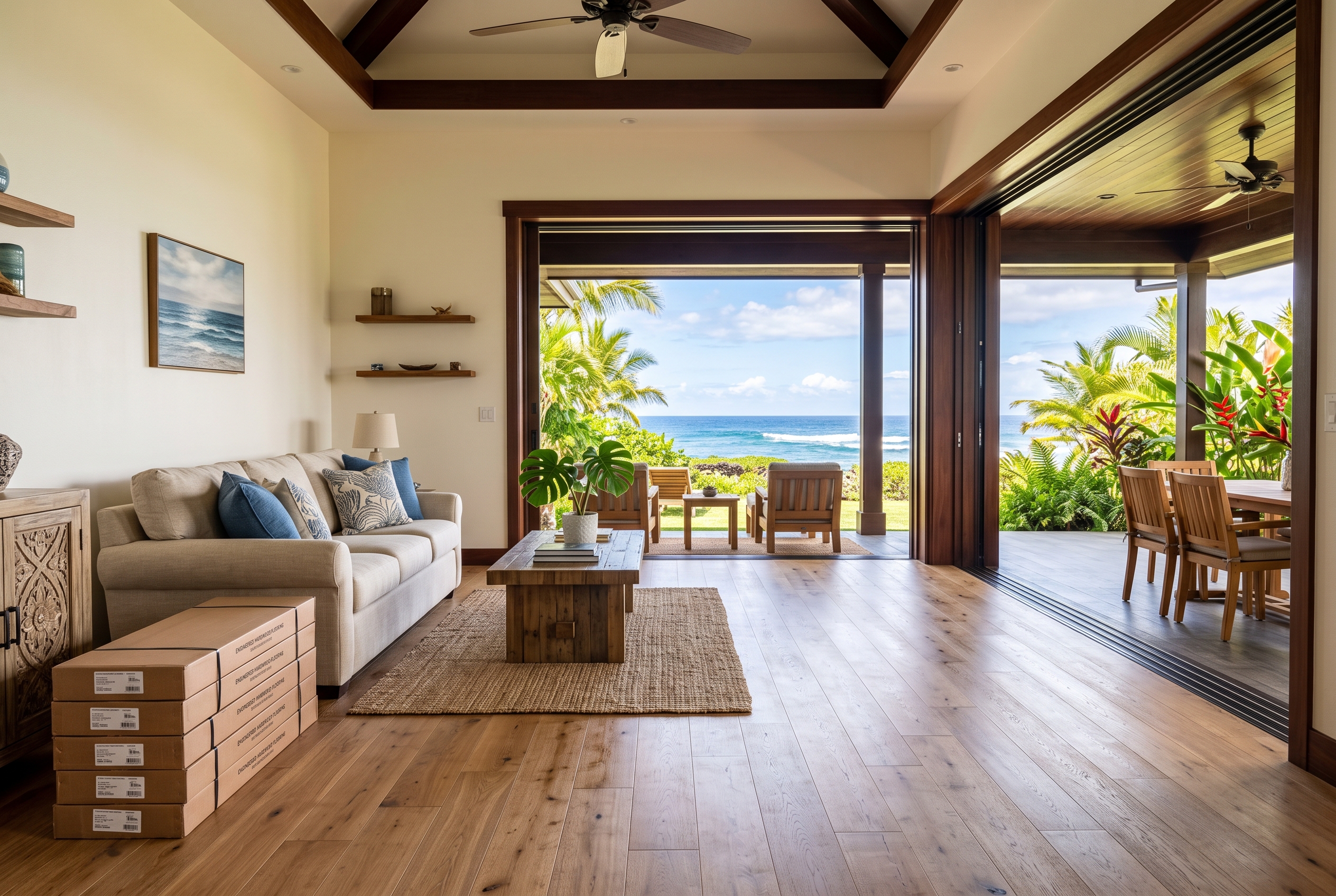
Hardwood floor installation in a Hawaii home comes down to two things: what is under the floor and how you run the house. A raised wood subfloor can take nailed solid or engineered wood. A concrete slab takes engineered wood that is glued down or floated. Before a single board is fastened, the wood has to reach the moisture level your home holds all year, and in a humid island house that is wetter than most mainland guides assume.
A raised wood floor, the kind found in many older and upcountry homes, can take solid or engineered hardwood nailed into the plywood. The ground under the house has to be kept from sending moisture up into it.
A concrete slab, the usual base for newer homes near the coast, takes engineered hardwood glued to the concrete or floated over a moisture barrier, once the slab has been tested for moisture.
Tile or an old wood floor you want to cover can often stay put. Engineered hardwood can be glued or floated over tile that is flat and firmly bonded, which saves a messy tear-out.
A house that lives with its windows open holds more moisture than the air-conditioned homes wood makers design for. That points toward engineered wood from a maker whose humidity range fits your house, or toward running the air conditioning or a dehumidifier.
A new floor that is already cupping or gapping is usually reporting a moisture problem, not a bad floor. Find and fix the source before anyone sands, because small gaps that open in dry months and close again are normal, and many cupped floors flatten once they dry.
| Your home | Wood that fits | How it is fastened | Room back in |
|---|---|---|---|
| Raised wood subfloor | Solid or engineered | Nailed or stapled | Same day |
| Concrete slab | Engineered | Glued down | 1 to 2 days |
| Concrete slab or tile | Engineered click-lock | Floated over a pad | Same day |
| Unfinished boards, any base | Solid or engineered | Nailed or glued, then finished | Several days |
Solid or Engineered Hardwood for a Hawaii Home
Engineered hardwood is the safer choice on a concrete slab and in any home that is not climate-controlled. Solid hardwood works well over a wood subfloor in a home kept in a steady range of temperature and humidity. Both are real wood on top, so the choice comes down to how each handles moisture and what it can be fastened to.
Solid hardwood is one piece of wood from face to back. It swells across its width when it takes on moisture and shrinks when it dries, and wide boards move the most. It needs a wood subfloor, so on concrete it takes a plywood layer built over the slab first. In exchange, it can be sanded and refinished many times over its life.
Engineered hardwood has a real hardwood top layer bonded to a core of cross-laid layers, and that cross-grain core resists swelling and shrinking. Because it moves so little, it can go on, above or below ground level, and it can be nailed, glued or floated. Our page on exotic and engineered hardwood shows how the layers go together. Engineered wood is more stable than solid but not waterproof, and it still wants a dry base and a house that does not swing wildly in humidity.
Where you live on the island matters too. On the Kona coast, warm air and trade winds through open windows keep indoor humidity high most of the year. Upcountry in Waimea and Volcano, nights are cool and damp, and homes are more often closed up.
Both are wetter than the air-conditioned average most wood is made for, which is why engineered wood is usually the practical answer here unless the house is kept cool and dry. We carry both solid and engineered floors, including exotic and tropical species, in our hardwood collection.
Acclimating Hardwood in Hawaii's Humidity
Acclimating hardwood means bringing the wood to the moisture level your home will hold year-round, and a moisture meter, not the calendar, says when it is there. The National Wood Flooring Association (NWFA) puts it plainly: wood that already matches the home's normal living conditions and the subfloor can be installed right away. Wood that does not sits in the house until it does. Our acclimation service starts every hardwood installation, and it usually takes one to three days, depending on the weather and the humidity inside the house.
The catch in Hawaii is what "normal living conditions" means. The NWFA's general rule for solid wood is a home held between 60 and 80 F and 30 to 50 percent humidity, and it says outright that there are geographic exceptions. In some climates the ideal average runs 45 to 65 percent, and some makers produce flooring wetter or drier to suit a region. USDA figures quoted in the same guidelines put wood inside homes in damp, warm coastal areas at about 11 percent moisture, against about 8 percent for most of the country.
That gap is the whole story for a Kona home. Wood dried for a mainland house and installed in a house that lives with its windows open takes on moisture and swells after it goes down. Wood acclimated to that open-window house shrinks a little if you later close up and run the air conditioning. Neither is a problem when the floor is chosen and acclimated for the way you actually live.
The maker's own range decides the warranty. Hallmark Floors, one of the hardwood brands we carry, asks for the air conditioning running and the house at 60 to 80 F and 30 to 50 percent humidity. It also asks for the house to sit at its year-round conditions for a week before installation.
If your house will not live in that range, say so at the estimate. The floor you choose can then be one whose maker allows the conditions you have, or you can plan on air conditioning or a dehumidifier.
Acclimation, done properly, follows these steps:
- For a week before the wood arrives, run the house the way you will live in it: the same windows open or closed, the same air conditioning schedule.
- The wood is delivered to the rooms where it will go, not left in a garage or on a lanai.
- The moisture of the wood and of the subfloor is checked with a meter. On a wood subfloor, the subfloor should read no more than 2 to 4 points wetter than the flooring, depending on board width.
- If the wood needs to take on or give up moisture, the boxes are opened and the boards stacked with spacers so air reaches every side.
- Installation starts when the readings line up.
Tropical and imported species can take two to three times as long to settle as domestic woods, because they are dense and oily, so plan a little extra time for them. You can follow along with a hygrometer, a small humidity gauge from any hardware store, set in the room where the wood will go. Our hardwood flooring guide covers species, stains and finishes.
Nail-Down, Glue-Down or Floating Hardwood
The subfloor decides the installation method. A wood subfloor takes nailed or stapled hardwood, a concrete slab takes glued or floating engineered hardwood, and tile can take glued or floating engineered hardwood. Each method feels and sounds a little different underfoot, and each gives the room back on its own schedule.
Nailing Hardwood to a Wood Subfloor
Nail-down installation fastens each board to a plywood subfloor with nails or staples driven at an angle through the tongue, where the next board hides them. It is the traditional method for solid hardwood, many engineered floors use it too, and it gives the solid, quiet feel people associate with wood. A moisture-retarding paper or membrane usually goes between the plywood and the boards.
On a single layer of subfloor, the boards run across the floor joists for strength. Running them the same direction as the joists takes a second layer of plywood or bracing between the joists. The room can be walked on as soon as the last board is in.
Gluing Hardwood to a Concrete Slab
Glue-down installation spreads adhesive over the concrete with a notched trowel and sets engineered boards into it. Many of today's urethane adhesives also act as a moisture barrier, which is why they are common on slabs. The slab has to be flat and must test dry enough for the adhesive maker's limit.
Glued floors feel solid and sound like the concrete under them. Keep foot traffic off it for at least a day, or longer if the adhesive maker says so, and give heavy furniture a second day while the adhesive cures.
Floating an Engineered Hardwood Floor
A floating installation clicks engineered boards together into one large panel that rests on an underlayment pad without being fastened down. On a slab, the pad carries a moisture film. It is the quickest method, it can go over tile that is sound and flat, and the room can be used as soon as it is done.
Floating floors sound slightly hollower than nailed or glued ones, and it needs room to move at every wall. Not every engineered floor can float, and the maker's instructions say which methods a product allows. Underlayment is one of our services.
Getting the Subfloor Flat, Dry and Solid
A good hardwood floor needs a subfloor that is flat, dry and solid. Wood telegraphs every dip and hump under it as a soft spot, a click or a hollow sound, and it soaks up whatever moisture sits underneath.
Flatness is checked with a long straightedge: no gap deeper than about 1/8 inch under 6 feet for glued and floating floors, with a little more allowance for nailed ones. High spots are sanded or ground down and low spots are filled.
Dryness is proven by testing, every time. The NWFA's guidelines call moisture testing compulsory practice whatever the conditions look like, because moisture trapped under a new floor is what most often ruins one.
Solid means no squeaks, loose panels or bounce. Loose sheets are screwed down and damaged ones replaced before any wood goes on. Subfloor repair is one of our services, and our NWFA-certified installers are trained in moisture testing with meters and in preparing subfloors for flatness and stability.
Concrete Slabs Near the Coast
Every concrete slab gives off some moisture, so the question is how much and what stops it. A slab is tested before engineered wood is glued or floated over it, and the result is compared with the flooring or adhesive maker's limit. A moisture-cure adhesive or a membrane then keeps the slab's moisture away from the wood.
A new slab needs at least two months to dry before a wood floor covers it. An old slab tells its own story: damp patches, a white powder on the concrete, or an old floor's glue that has let go all mean moisture is coming up. Those get sorted out before hardwood goes down.
Raised Floors Over a Crawlspace
Raised floors are common in older Hawaii homes and upcountry, where houses stand on posts and piers over an open crawlspace. The moisture risk comes from the ground under the house. Soil gives off moisture into the crawlspace, and a vapor retarder, a sheet of heavy plastic laid over the ground, cuts that down sharply.
Before hardwood goes on a raised floor, look under the house. The ground should be covered, the space should stay open to the air, and the plywood should read close to the new flooring on a moisture meter. Closing in an open crawlspace with skirting and vents can trap moisture in a hot, humid place, so change the underside of the house only with care. Check for squeaks and bounce from inside, and for termite damage in the framing from underneath, before new wood goes over it.
Installing Hardwood Over Tile or an Existing Floor
Yes, engineered hardwood can go over tile or an old wood floor, as long as the old floor is intact, flat and firmly bonded. It saves the dust, noise and cost of breaking out tile, and we install over existing tile and hardwood that are still intact.
Over tile, the wood is glued or floated; nailing is out. Loose tiles and cracked grout are fixed first, deep grout lines are filled, and the surface is cleaned so the adhesive can grip. Over an old nailed wood floor, new wood can be nailed on top, with an extra layer of plywood if the new boards run the same direction as the old ones. New wood never goes over an existing floating floor, and carpet always comes up first.
Covering an old floor raises the new one. Doors may need trimming, the dishwasher and range have to clear, and doorways into rooms that keep the old floor need a transition piece; our guide to floor transition strips covers the options. If the floor you want to cover is solid hardwood, check first whether it could simply be sanded and refinished. Our refinish-or-replace guide walks through that decision.
Getting Your Home Ready for Hardwood Installation
Getting ready for hardwood installation means finishing the wet and messy work first, emptying the rooms, and keeping the house at its everyday conditions. Work through this list in the week or two before the wood arrives:
- Finish drywall, plaster, tile and painting, and let them dry. The last coat of paint on the baseboards can wait until after the floor.
- Keep the house at its everyday temperature and humidity for the week before delivery.
- Plan the furniture. Furniture removal is one of the services we offer; ask about it at the estimate.
- Empty the closets that are getting wood, and clear anything breakable off low shelves.
- Decide about the refrigerator, range, washer and any toilet in a room getting wood, since each has to come out and go back.
- Decide on the trim. Baseboards are either taken off and put back over the new floor, or left in place with a quarter round added; we install baseboards and quarter round to match.
- Clear a parking spot and a shaded place outside for cutting boards, which keeps most of the saw dust out of the house.
- Plan for noise and dust. Nail guns and saws are loud, and pets and small children are happiest away for the day.
You can stay in the house during a hardwood installation, in the rooms that are not being worked on. The kitchen is the hardest room to live without, so if it is part of the job, plan simple meals for a day or two.
Hardwood Installation Day by Day
Hardwood installation takes longer than the fastening alone suggests, because the wood arrives days before the first board goes down. For a typical 1,000 square feet of engineered hardwood, Hallmark Floors lays out about 10 to 14 days from delivery to the sofa going back, most of it acclimation. It puts a professional two-person crew's pace at 500 to 750 square feet a day. Here is the usual order for a prefinished floor:
- Delivery and acclimation. The wood comes into the rooms where it will go and sits until the meter says it is ready.
- Tear-out. The old floor comes up, down to the subfloor, unless the new floor is going over it. When the old floor is carpet, carpet disposal is one of our services.
- Subfloor preparation. Moisture readings, flattening, screws for squeaks, repairs, and the underlayment or membrane.
- Layout. A straight starting line is snapped, usually along the longest, most visible wall, and boards are pulled from several boxes at once so color and grain blend.
- Fastening the rows. Boards are nailed, glued or clicked row by row, with the end joints staggered so no two line up.
- Detail work. Door casings are undercut so boards slide under them, and boards are fitted around cabinets, islands, closets and floor vents. This is the slow part.
- Trim and transitions. A gap left at the edges for the wood to move is hidden under the baseboards or quarter round, and doorways get their transition pieces.
- Cleanup and walk-through. The floor is cleaned and checked board by board with you.
Which Way the Boards Should Run
On a raised floor, hardwood boards run across the floor joists, because that is where the subfloor is strongest. On a slab, or with a floating floor over thick plywood, the direction is a design choice. Boards along the longest wall make a room look longer, and boards running toward the main window or lanai door let the light travel down the grain. Keep one direction through rooms that open into each other.
Prefinished Boards or a Floor Finished in Place
Two finishes decide the schedule: prefinished, where the boards arrive with a factory finish, and finished in place, where bare boards are installed, sanded flat and finished in your home. Prefinished floors are ready when the last board is in, with a hard factory coating and no finish smell. A floor finished in place takes several extra days out of the room, but it gives a perfectly flat surface, any stain color you want, and the seams between boards sealed under the finish.
Sanding, staining and finishing are the core of our hardwood refinishing service. For most Hawaii homes, prefinished engineered wood is the practical choice, because it goes down quickly and lives with humidity better.
When You Can Walk on New Hardwood and Move Furniture Back
When you get the room back depends on the method and the finish. A nailed or floating prefinished floor can be walked on right away, a glued floor needs a day or two, and a floor finished in place needs several days.
| Floor | Walk on it | Furniture back |
|---|---|---|
| Nailed, prefinished | Right away | Same day, on felt pads |
| Floating, prefinished | Right away | Same day, on felt pads |
| Glued, prefinished | In socks after 24 hours | After about 48 hours |
| Finished in place | Per the finish, often a day | Several days to a week |
Whatever the method, lift furniture into place instead of sliding it, and put felt pads on every leg first. Hold off on rugs over a floor finished in place until the finish has cured, which the finish maker's instructions state.
Hardwood in Kitchens, Bathrooms, Stairs and Lanai Doors
Hardwood suits most rooms of a Hawaii home, with the rooms that stay wet as the exception. Kitchens are fine with care: wipe spills quickly, use a mat at the sink, and fix a leaking dishwasher line the day you notice it. Full bathrooms and laundry rooms are the wrong place for hardwood, because standing water and shower steam work into the joints. A powder room with no tub or shower can take it with care.
Stairs are fitted one tread at a time, with a matching stair nosing on the front edge of each step, and they are slow, careful work. Lanai and entry doors bring sand, sun and rain onto the first few feet of floor. A mat inside the door, shades on west-facing glass, and a quick sweep of grit keep the finish looking new.
What Hardwood Installation Costs
Hardwood installation is priced by the square foot for the wood and the labor, and the method, the subfloor work and the finish move the total. As a national reference, the Homewyse cost calculator puts a basic engineered floor, material and installation, at about $8.25 to $13.32 a square foot. It puts a basic nailed solid oak floor at about $13.77 to $17.48.
At those national rates, 800 square feet of living areas would come to roughly $6,600 to $10,700 in engineered wood, or $11,000 to $14,000 in solid oak, before tear-out and extras. Those are national figures in easy conditions, and a Hawaii job also carries freight for the wood.
| Item | What it adds | Note |
|---|---|---|
| Tear-out and disposal | Labor and haul-away | Tile takes longest to remove |
| Subfloor flattening | Grinding, filling, screws | Found once the old floor is up |
| Moisture control | Membrane or special adhesive | Common on slabs |
| Finishing in place | Sanding, stain, coats | Adds days as well as cost |
| Stairs | Priced per step | Treads, risers and nosing |
| Trim and transitions | Baseboard, quarter round, thresholds | More with many doorways |
| Waste allowance | Extra boxes ordered | More for diagonal layouts |
Engineered wood usually costs less to install than solid, because floating and glue-down go faster than nailing solid boards and there is no sanding. Order a little extra either way, and keep a box after the job; a matching board is hard to find years later when one needs replacing. We price your floor from your own rooms at a free in-home estimate, and financing is available.
Cupping, Gaps and Squeaks in a New Hardwood Floor
When a new hardwood floor cups, gaps or squeaks, moisture is the first suspect and the subfloor the second. Wood that takes on moisture swells and cups, with the edges of each board higher than the middle. Wood that dries out shrinks and opens gaps between the boards.
| What you see | Likely cause | What fixes it |
|---|---|---|
| Edges higher than centers | Moisture from underneath or a leak | Find the source, dry, then reassess |
| Centers higher than edges | Cupped floor sanded too soon | Let it settle, then refinish |
| Gaps in dry months | Normal seasonal shrinking | Usually close again on their own |
| Gaps that never close | Wood installed too wet | Filling or board work |
| Boards lifting off the floor | Flooding or no room to expand | Remove, dry, repair or replace |
| Squeaks or hollow spots | Loose fasteners, glue voids, dips | Refasten, inject, or re-lay |
Cupping is usually a moisture problem, and the floor is the messenger. It comes from moisture rising from a slab or crawlspace, a plumbing leak, or a house much damper than the wood was acclimated to. Fix the source first and give the floor time to dry back; many cupped floors flatten on their own. Sanding a cupped floor flat before it dries leaves the boards crowned, higher in the middle, once they do.
Small gaps that open in the drier months and close again are normal wood behavior. Gaps that are large, or that stay open through the humid months, need a closer look. After a storm or a flood, dry the floor quickly and have it checked. Flood service and flooring repairs are both among our services, and a damaged area can often be repaired rather than replaced.
Living With a New Hardwood Floor in Hawaii
A hardwood floor lives best in the conditions it was installed in. Keep the house near those conditions year-round; a hygrometer on a shelf tells you where you stand. In the wettest weeks, run the air conditioning or a dehumidifier.
A second home or a rental that sits closed between visits needs air moving while it is empty. A dehumidifier on a timer, or the air conditioning set to cycle, keeps a shut-up house from turning damp and cupping the floor.
- Put mats inside every door to catch sand and grit before it reaches the finish.
- Use felt pads under furniture and replace them when they wear thin.
- Dust-mop or vacuum with a hard-floor setting; skip steam mops and wet mopping, and use the cleaner the maker recommends.
- Wipe up water right away, especially at the sink, dishwasher and lanai door.
- Use shades on strong afternoon sun and move rugs now and then, since wood changes color with light.
Dogs are welcome on hardwood with a little planning. Keep their nails trimmed, and consider a textured finish such as hand-scraped or wire-brushed, which hides light scuffs and scratches far better than a glossy smooth one.
When the finish wears years from now, most hardwood can be sanded and refinished, and a thick engineered top layer can usually take it too. The refinish-or-replace guide explains how many times each kind can be sanded.
Our Hardwood Installation Service in Kailua-Kona
At Floor Expert LLC, we install solid and engineered hardwood in new construction and in homes replacing a worn floor, from the Kona coast up to Waimea and around to Volcano. Every installation starts with our acclimation service, and we install over existing tile and hardwood that are still intact.
Our team is NWFA certified, and our installers are trained in acclimation, moisture testing with meters, all three installation methods and subfloor preparation. We also handle subfloor repair, underlayment, furniture removal, baseboards and quarter round, and hardwood repair and refinishing. Stop by our Maiau Street showroom to see the boards in person, or shop at home and look at samples in your own rooms and light. We are locally owned and family operated, and our certifications page explains what each credential covers.
Questions People Ask About Hardwood Installation
Can I Install Hardwood Flooring Myself?
Yes, if you are handy and choose a floating engineered floor over a flat, dry subfloor. Nail-down and glue-down hardwood installations need special tools, moisture testing and practice, and a mistake shows for years. Every maker's warranty depends on following its installation instructions, which is why we recommend professional installation for most hardwood.
Does Hardwood Need an Underlayment?
Yes, most hardwood installations need an underlayment of some kind. Nailed floors usually go over a moisture-retarding paper or membrane, floating floors go over a pad with a moisture film on slabs, and glued floors rely on the adhesive or a membrane under it. The flooring maker's instructions name what is allowed.
Should Hardwood Go In Before or After Cabinets?
It depends on the floor: a nailed solid floor often goes in before the cabinets in new construction, while a floating floor goes in after them, because cabinets must never pin a floating floor down. Either way, the drywall, tile and painting come first.
Can New Hardwood Be Added to Match an Existing Floor?
Yes, in most cases new hardwood can be woven into an existing floor, and the whole area sanded and finished together so the old and new read as one floor. The species, board width and age of the old floor decide how close the match can get. Hardwood add-ons are part of our refinishing work.
Can Hardwood Go in a Condo?
Yes, hardwood can go in most condos, usually as engineered wood over an underlayment that meets the building's sound rating for the unit downstairs. Most associations require approval and set rules on underlayment and work hours, so get the rules before the estimate.
Plan Your Hardwood Installation
Most of what makes a hardwood floor last in Hawaii is decided before installation day: what the subfloor is, how dry it is, how you run the house, and which wood and method suit all three. That is what the estimate is for. Book a free in-home estimate, and we will measure the rooms, go over the solid and engineered choices that suit your house, and set a plan for acclimation and installation.


