

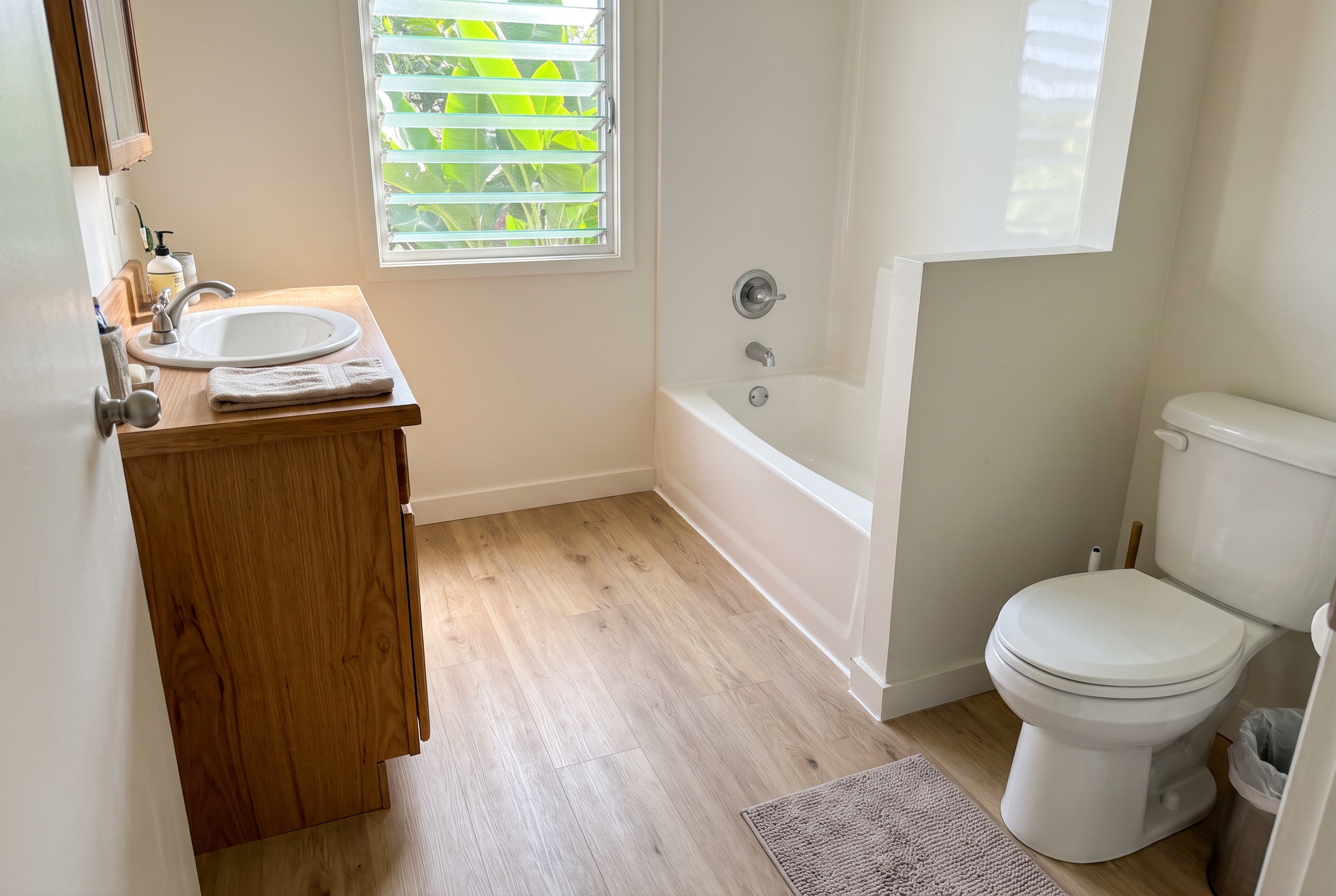
When a bathroom floor is replaced, the toilet comes up first. The new floor runs right up to the drain pipe under it, and then the toilet goes back down on top of the new floor with a new seal. A vanity you're keeping stays where it is, and the floor stops neatly at its base. At the tub, the floor stops a little short, and that small gap is sealed the way the floor's maker says.
If the floor around your toilet feels soft, or the toilet rocks when you sit down, water has most likely been getting into the wood under it for a long time. That wood gets cut out and replaced before any new floor goes in. Left alone, a soft floor keeps flexing, and that will break the toilet's seal again.
The Order of Work for a New Bathroom Floor
The order is the same whether the new floor's planks click together or get glued down. In a small bathroom where the floor underneath is in good shape, the whole list is often done in a day.
The room is emptied. Bath mats, the trash can, the hamper and anything stored beside the toilet come out. If the vanity is being replaced, its cabinet gets emptied too.
The water is shut off and the toilet comes up. The tank and bowl are drained, the bolts come off and the toilet lifts straight up. Under it is a ring of wax that sealed it to the drain. That old wax is scraped away, and the drain is plugged so sewer gas stays out of the house.
The trim along the walls comes off, or stays. Baseboard that comes off cleanly goes back later over the new floor's edge. Baseboard that stays gets a thin rounded strip, called quarter round, along its foot.
The old floor comes up, or gets covered. Sheet vinyl, old tile or an old click floor is taken up, unless it's flat, solid and a kind the new floor's maker allows you to cover.
The subfloor is checked and fixed. The subfloor is the plywood or concrete the old floor was laid on. Soft or water-stained wood around the toilet and tub is cut out and replaced. Bumps are ground down and dips are filled until the floor is as flat as the new floor's maker requires.
The rows are planned. The layout is set so the doorway and the area around the toilet get good-sized pieces, not thin slivers.
The new floor goes down. The planks click together or go into adhesive, and they're cut to fit around the pipes and the toilet drain. A small gap is left at every wall, along the tub and at the vanity.
The edges are sealed and trimmed. Silicone goes where the maker calls for it, usually along the tub and around the toilet drain. Then the baseboard or quarter round covers the edges, and a strip finishes the doorway.
The toilet goes back. It's set on a new wax ring, bolted down and checked for leaks.
Why the Toilet Comes Up
The toilet comes up even when nothing else in the room is changing. Under it, the drain pipe ends in a flat ring called the flange, and the toilet bolts to that ring. The ring of wax between the toilet and the flange is what keeps the seal watertight. For that seal to work, the toilet has to sit on the new floor, so the new floor has to run all the way to the flange.
It's possible to leave a toilet in place and cut the new floor around its base, but it's a poor trade. The cut has to follow the curve of the porcelain, so it's hard to seal well, and splashes from the bowl or a wet towel land right on it. The toilet also stays down at the old floor's level while the new floor rises around it.
Mannington's instructions assume the toilet is off. Its installation guides for its vinyl and laminate floors put 100 percent silicone caulk at the toilet flange, with the new floor running to the drain and the toilet set back on top.
A few things happen while the toilet is off that you'll never see. The toilet always goes back on a new wax ring, never the old one. A cracked or rusted flange is replaced before the floor goes down, because it's the part the toilet is bolted to. And if you're getting a new toilet anyway, it goes in after the floor, the same way.
Will the Toilet Sit Higher on the New Floor?
A little, sometimes, and that's normal. The flange should sit on top of the finished floor, or up to a quarter inch above it, so the wax ring squeezes tight between the flange and the toilet. A new floor that's thicker than the old one can leave the flange sitting low, and a low flange is where leaks start.
How much the floor rises depends on how thick the new floor is and how thick the old one was. These are the thicknesses the makers list for the lines we carry.
Floor we carry | Type | Thickness |
|---|---|---|
Karndean Korlok Select | Click vinyl with a stiff core | About 1/4 inch (6.5 mm) |
Mannington ADURA Apex | Click vinyl with a foam pad on the back | About 5/16 inch (8 mm) |
Karndean Art Select | Glue-down vinyl | About 1/8 inch (3 mm) |
Mannington ADURA Flex | Glue-down vinyl | About 1/10 inch (2.5 mm) |
Mannington Restoration Collection | Laminate | About 1/2 inch (12 mm), plus a separate pad up to 1/8 inch |
If old sheet vinyl comes up and a thin glue-down floor goes in, the flange usually ends up close to where it was. If a thick laminate goes over the old floor, the flange will sit low. The fix is a plastic spacer ring set on the flange and sealed to it with silicone, with the new wax ring on top. Stacking two wax rings is the shortcut to avoid. It's common, and it's the one that fails, because the joint between the two rings is where a leak starts. If the flange would need more than about three spacers, the right fix is to reset the flange itself.
The Vanity: Work Around It or Take It Out
If you're keeping the vanity, it stays put and nothing is cut under it. The new floor runs to the front and sides of the cabinet and stops a small gap short, and a slim strip of trim covers that edge so it looks finished. That's the usual way, and the cheapest, because the sink stays hooked up.
A new vanity changes the order, and what decides it is how the new floor is held down. A floating floor is one that clicks together and lies loose on the subfloor, with no glue, so it can move a little with heat and humidity. With a floating floor, the new vanity goes in first, set on the subfloor, and the floor runs up to it. A cabinet fastened down on top of a floating floor pins it in place, and a floor that can't move lifts or opens at the seams. Mannington rules out cabinets on top of its ADURA Apex vinyl, and Gaia says the same about cabinets on its Nearwood laminate.
A glue-down floor is stuck to the subfloor everywhere, so it isn't meant to move, and a new vanity can sit right on top of it. A pedestal sink or a wall-hung vanity is simpler still, because the floor just runs underneath.
Keeping the old vanity has one catch later on. If you swap it for a smaller one someday, the patch where the old cabinet stood will show. That's a good reason to keep a spare carton of your new floor in a dry closet.
Where the Floor Meets the Tub or Shower
The floor stops a small gap short of the tub and never runs under it. Depending on the floor, that gap is somewhere between 3/16 and 1/2 inch, and it's there so the floor can move. In a bathroom, the gap is also where water would sneak under the floor, so it's sealed with silicone, which stays flexible as the floor moves.
How much of the room gets sealed depends on the floor's maker, and the makers don't all agree. Mannington's guides call for silicone along the tub and around the toilet, and for its laminate, all the way around the room. Urban Floor seals the whole gap around the room too. Karndean, on its click vinyl, uses silicone only at fixtures where water actually lands, and asks for a strip at the bathroom door so the sealed floor can move on its own. Your floor should follow its own maker's rule.
None of these floors goes inside a shower or into a room that stays wet. Karndean rules out rooms that will be continually wet, and Mannington and Gaia rule out steam rooms and saunas. Gaia also says Nearwood is never laid over a floor drain. So the floor runs up to the low lip at the edge of the shower and stops there, and a walk-in shower keeps its own floor.
A freestanding tub is heavy and stays in one place for good, so with a click floor it's treated like a new vanity. It stands on the subfloor and the floor runs around its feet, or it goes on a glue-down floor.
That bead of silicone along the tub isn't forever. Run a finger along it once a year, and redo any stretch that has pulled loose or turned dark.
Which Floors the Makers Allow in a Bathroom
Vinyl doesn't mind water, which is why it's the usual bathroom floor. Karndean calls both its click and glue-down vinyl suitable for ordinary home bathrooms, and Mannington describes its ADURA Apex vinyl as completely waterproof. Laminate is built on a core of pressed wood fibers, so its makers focus on sealing the edges. Mannington describes its Restoration Collection laminate as waterproof and lists bathrooms among the rooms it's made for. Urban Floor says its The Blvd laminate can go in almost any room, bathrooms included.
Line we carry | Type | What its maker says about bathrooms | Gap and sealing |
|---|---|---|---|
Karndean Korlok Select and Reserve | Click vinyl | Suitable for home bathrooms, not rooms that stay wet | 3/16 inch gap; silicone only where water lands; a strip at the door |
Karndean Art Select and Da Vinci | Glue-down vinyl | Suitable for home bathrooms, not rooms that stay wet | A stronger two-part glue where the floor gets wet often |
Mannington ADURA Apex | Click vinyl | Completely waterproof | 1/4 inch gap; silicone along the tub and toilet |
Mannington ADURA Flex | Glue-down vinyl | Gives steps for tubs and toilets | Silicone along the tub and toilet; nothing heavy on it for 24 hours |
Mannington Restoration Collection | Laminate | Waterproof; made for bathrooms | 5/16 inch gap, filled with silicone all the way around |
Urban Floor The Blvd | Laminate | Fine in kitchens and bathrooms | 1/2 inch gap; a foam cord and silicone all the way around |
Gaia Nearwood | Laminate | No bathroom rule; wants a climate-controlled room | 3/8 inch gap; never over a floor drain |
Which of these fits your bathroom depends on how wet it gets. In a kids' bathroom where the floor gets splashed every night, choose vinyl, or a laminate whose maker seals the whole room. A powder room with no tub can take any of them. Gaia asks that a room with Nearwood stay between 35 and 55 percent humidity all year, so it suits a bathroom in a house that runs air conditioning. And Karndean's guide suggests sealing no more than about 43 square feet of click vinyl this way, which covers most bathrooms.
All of these lines are in our luxury vinyl catalog and our laminate catalog. If you're hoping for wood, our guide to how hardwood installation works in Hawaii explains why a powder room can take it with care while a full bathroom is the wrong place for it. And if you're still choosing between vinyl plank and tile, we've compared the two for Hawaii bathrooms.
What's Under an Old Bathroom Floor
You won't know for sure until the old floor comes up, but bathrooms tend to show the same few things. Older houses often have sheet vinyl glued to plywood, or vinyl tiles. Ceramic tile may sit on a thick bed of mortar. Around the toilet and along the tub, the plywood is often stained, and sometimes soft.
Old vinyl deserves care before anyone scrapes it. The EPA lists vinyl floor tiles, the backing on sheet vinyl and the glues used with them among the places asbestos can turn up in homes. Its advice is not to sand or scrape that kind of flooring and, where you can, to cover it instead of tearing it out. Mannington's guides tell installers to treat old vinyl and its glue as if they contain asbestos unless they know otherwise, and they note that local rules may require testing first.
Covering the old floor is often possible, and it saves the mess. Vinyl plank can usually go right over old tile, sheet vinyl or a concrete slab, as long as the old floor is flat and solid. In a bathroom, the added height matters more than elsewhere, because both the toilet flange and the door have to clear it.
On a Kona slab, the question is moisture coming up through the concrete. Each maker sets a limit for how much moisture the slab may give off, measured before the floor goes down, and the limits differ. Mannington's Restoration laminate accepts less moisture than its ADURA Apex vinyl, and Karndean's Korlok vinyl accepts more than both. The makers also disagree about putting a heavy plastic sheet on the concrete. Gaia and Urban Floor require one under their laminate, while Mannington recommends against one directly under ADURA Apex. Each floor follows its own maker.
In an older house built up on posts, the bathroom floor is plywood over the open space under the house. The makers have rules for that too. Mannington wants a wood floor at least 18 inches off the ground, with air moving underneath and a vapor barrier covering the dirt. Gaia asks for heavy plastic sheeting on the ground and vents left open all year.
A Soft Spot or a Rocking Toilet
A floor that gives a little beside the toilet, a toilet that rocks, or a dark stain creeping out from its base almost always means water has been getting into the wood for a long time. The usual sources are a wax ring that has leaked a little with every flush, a tank that sweats in humid weather, or water splashed over the tub edge for years.
It won't fix itself, and it won't stay the same size. A soft floor flexes every time someone sits down, and that movement breaks the toilet's seal and lets more water in. When the old floor comes up, the rotten plywood is cut back to solid wood, the floor beams under it are reinforced if they need it, and new plywood goes in before the new floor. If the flange was sitting on rotten wood, it gets a solid base too.
We repair subfloors, and a bathroom with the floor already up is the cheapest time to do it.
How Long You'll Be Without the Bathroom
The floor itself is the quick part. In a small bathroom, putting down the new floor is a few hours' work. The rest of the day goes to the toilet, to taking up the old floor and to fixing whatever turns up under it.
So a small bathroom with a click floor and a sound subfloor is often finished in a day, with the toilet working again that evening. A glued floor needs its adhesive to set. Mannington asks for 24 hours before anything heavy goes on ADURA Flex. For Karndean's glue-down floors, the wait depends on the adhesive used. A subfloor repair adds time, and so does tile that has to be broken out.
If it's the only bathroom in the house, plan around that day. The toilet can be used again as soon as it's back on its new wax ring and checked for leaks. Before the day comes, clear the floor and the counter, and take down anything hanging over the toilet. If the vanity is coming out, empty it. Keep kids and pets out of the room while the drain is open.
Caring for a New Bathroom Floor
Bath mats are the first thing to change. Rubber- or latex-backed mats can stain vinyl and laminate, so choose mats sold as non-staining. Put felt pads under a stool or a hamper that gets pushed around.
Wipe up standing water after a shower. Vinyl won't be harmed by it, but a wet floor is slippery. On laminate, water left sitting is what finds its way into the edges, so laminate is never mopped with a flood of water. Whether you can use a steam mop depends on the floor. Gaia rules them out on Nearwood, while Mannington approves them for its Restoration laminate. Run the fan after showers too, because a bathroom that dries out quickly is easier on every floor in it.
Our Bathroom Flooring Work
At Floor Expert, we put new floors into bathrooms, either as part of a kitchen or bathroom remodel or as a job on their own. We install luxury vinyl, both glue-down and click, along with laminate. When the plywood around the toilet has gone soft, we repair the subfloor before the new floor goes down.
If you'd rather see the floors in your own bathroom light before choosing, we'll bring samples to your door after a quick phone call. We're certified by CFI for installing floating vinyl plank and laminate, and CFI is a group that trains and certifies flooring installers. We're also certified by the NWFA, the wood flooring trade association.
The first step is a free estimate in your home with one of our project specialists. Our showroom sits on Maiau Street in Kailua-Kona, and we work in homes all the way from Waikoloa and Waimea south to Ocean View and around to Volcano.
More Questions About Replacing a Bathroom Floor
Can a New Floor Go Over the Old Bathroom Floor?
Yes, when the old floor is flat, firmly stuck down and a kind the new floor's maker accepts, such as one layer of sheet vinyl or sound tile. The new floor then sits on top of the old one, so the toilet flange often needs a spacer and the door may need trimming to clear it. If the old floor might contain asbestos, covering it is the route the EPA prefers anyway.
Can Just the Bathroom Get a New Floor?
Yes. Most click floors need a strip at the bathroom door anyway. Karndean asks for one when a bathroom's edges are sealed, so the bathroom floor can move on its own. Urban Floor wants a 1/2-inch gap between rooms for The Blvd, and Gaia puts a T-shaped strip in doorways up to 4 feet wide. That strip also handles any change in height or floor type, and which transition strip you need depends on the two floors meeting there.
Do the Baseboards Come Off for a New Bathroom Floor?
Not always. Baseboard that comes off cleanly goes back on over the new floor's edge. Baseboard that stays gets a strip of quarter round along its foot to cover the gap, and in a bathroom that trim is sealed where the floor's maker calls for it. We carry quarter round color-matched to vinyl plank, so the edge disappears into the floor.
Getting Your Bathroom Measured
A bathroom is a small room with a lot going on in it, so the next step is having someone look at yours in person. Book a free in-home estimate, and we'll measure the room and go over the floors that suit the way it gets used.


